Kate Raphael speaks with novelist Carolina de Robertis about her stunning new book, Cantoras, a story based on the real experiences of Uruguyan lesbians making a place for themselves and each other amidst the secrets and terror of the military dictatorship. The New York Times calls the book "brazenly hopeful ... a revolutionary fable, ideal for this moment." Carolina and I met over empanadas at Oakland's Cafe Santana; so you'll also learn the difference between Platense empanadas (those from the Rio de la Plata region of Argentina and Uruguay) and those from Chile, Peru and the Philippines.
Event: Meet the Authors, 20th Anniversary of NANOWRIMO at the SF Main Library, Wed, Nov 13 at 6 PM. Carolina will participate with a panel of writers to talk about their writing process and what it is like to write 50,000 words in a month.
Note from Kate Raphael: This will likely be the last time I will host Women's Magazine. Tune in to find out about what I'll be doing instead! Thanks to all of you for all your support over these many years, and I hope you will continue to be avid listeners and supporters of Women's Magazine. (Keep in touch with Kate at www.kateraphael.com. Click on contact and sign up for Kate's newsletter.)
Making your summer reading list? You’re going to want to hear about this sexy new book:
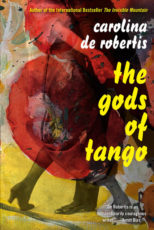
GODS OF TANGO, by Carolina de Robertis, is a steamy story of music, migration, romance and identity. Leda, a young Italian bride, arrives in Buenos Aires to find out that her husband has died. In seeking herself in her new country, Leda becomes Dante, playing violin in one of the bands taking the scandalous tango from the brothels and tenements to the high-society cabarets. Carolina de Robertis is the award-winning author of The Invisible Mountain and Perla.
From de Robertis' website:
February 1913: seventeen-year-old Leda, carrying only a small trunk and her father’s cherished violin, leaves her Italian village for a new home, and a new husband, in Argentina. Arriving in Buenos Aires, she discovers that he has been killed, but she remains: living in a tenement, without friends or family, on the brink of destitution. Still, she is seduced by the music that underscores life in the city: tango, born from lower-class immigrant voices, now the illicit, scandalous dance of brothels and cabarets. Leda eventually acts on a long-held desire to master the violin, knowing that she can never play in public as a woman. She cuts off her hair, binds her breasts, and becomes “Dante,” a young man who joins a troupe of tango musicians bent on conquering the salons of high society. Now, gradually, the lines between Leda and Dante begin to blur, and erotic desires that she has kept suppressed reveal themselves, jeopardizing not only her musical career, but her life.
Richly evocative of place and time, its prose suffused with the rhythms of the tango, its narrative at once resonant and gripping, this is De Robertis’ most accomplished novel yet.
On KPFA radio's Women's Magazine this Memorial day we will be presenting a special Memorial Day's tribute by daughters to the Mothers in their lives and around the world, from Argentina, to Palestine to Iran and in the U.S., to mothers who have survived the hidden war on women both damaged and whole, and been survivors, the peace makers, care takers in the family and in society. An alternative to the Hallmark Card version of Mother's Day and the Memorial Day celebration of soldiers this special recognizes our Mothers as the hidden soldiers.
THE GERMAN DOCTOR: Kate Raphael talks with filmmaker and novelist Lucia Puenzo, whose film THE GERMAN DOCTOR (WAKOLDA), adapted from her novel, opens next week.
An article in the New York Times over the weekend talked about something called "slow cognitive tempo," a new form of Attention Deficit Disorder which scientists are studying and doctors are busy diagnosing and medicating in kids.This is really nothing new but the stage is different, jobs are much fewer and it is harder and harder to make one's way in the world.And of course drug companies are always manufacturing new products and finding new uses for old ones to treat these supposed diseases and paying doctors to prescribe them and give out samples, and parents are not encouraged or educated to challenge the wisdom of doctors, and so on and so on.
This overdrugging of kids in order to make them fit into an ever narrowing box of acceptable behavior and capabilities is a form of social engineering that makes it possible for us to do less of the more overt types, but is no less harmful and it raises some tough questions of who is culpable and for what. It's easy to say that the people who design experiments on developmentally disabled people are evil. But I think most parents who give their kids Ritalin so they can do better in school and stop getting in trouble are really trying to do right by their kids. And most of the doctors who prescribe these drugs, and the scientists who research these supposed disorders, are also trying to help.
These are some of the questions at the heart of the new film by Argentine director Lucia Puenzo. The film is called in English THE GERMAN DOCTOR, and it opens on April 25 at the Embarcadero and the Albany Twin. It deals with the time that Josef Mengele spent in Argentina after the war. Lucia Puenzo is the author of five novels and the director of two previous films, Her debutfilm, XXY, won numerous awards including the Critics' Week grand prize at the 2007 Cannes film festival. The German Doctor is based on her novel, WAKOLDA, which is also the name of the film in Spanish.
Pamela Olson discusses her new memoir Fast Times in Palestine: A Love Affair with a Homeless Homeland. An East Oklahoma girl, Olson stumbled into Palestine and ended up staying for two years and becoming the press coordinator for a presidential candidate.
Carolina de Robertis talks with Nina Serrano and reads from her novel, Perla, which explores the legacy of Argentina's "dirty war" through one of the "stolen children" of the disappeared.
De Robertis grew up in a Uruguayan family that immigrated to England, Switzerland, and California. Prior to completing her first book, she worked in women’s rights organizations for ten years, on issues ranging from rape to immigration. She makes her permanent home in Oakland, California, though she is spending 2013 in Montevideo, where she’s working on her third novel, about migration, sexual frontiers, and the tango’s Old Guard in early twentieth century South America.
Carolina asked you to buy her book at your local independent bookstore.
You will hear about sexual harassment in Egypt, violence against women in Papua New Guinea and Saudi Arabia’s first female athletes to participate in the Olympics - courtesy of Al Jazeera. We share a Fox News feature on the execution of the Afghan woman, and analysis from MSNBC about Obama’s campaign strategy. The story on the recent mistreatment of Greek female politicians was produced by the Lansing State Journal. 5:54 min.